
Local birding spots
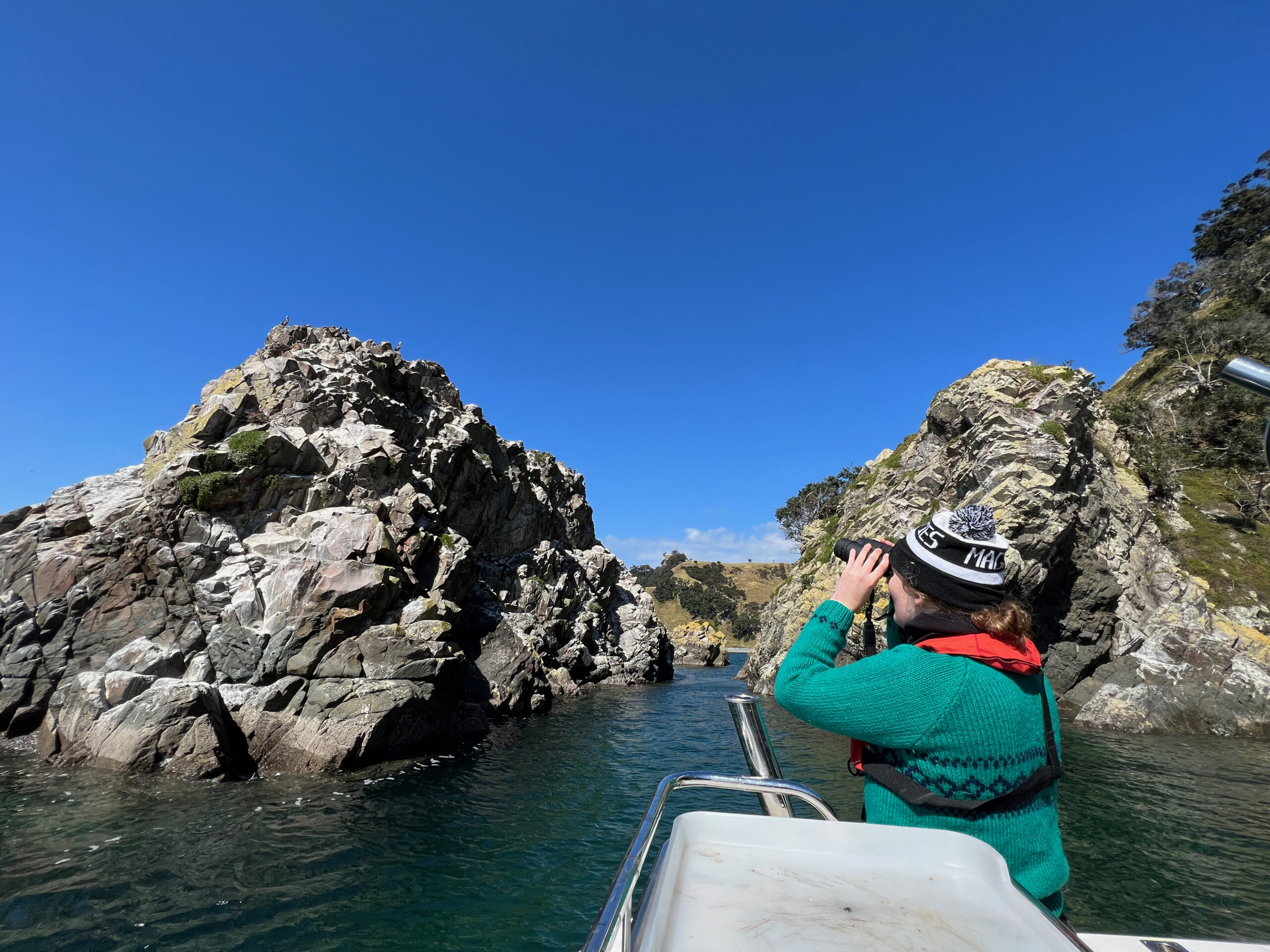 Spotted Shags at Hauraki Gulf by Josie Galbraith
Make sure you have time before or after the conference to go birding near Auckland – here are some suggestions for places to visit
Several of the best birding spots around Auckland will be included in our field trips and our list below excludes these, but it does include those in our morning walks tours.
Tāmaki Makaurau/Auckland is a birding hotspot for New Zealand and it has some of its own regional endemics including the NZ storm petrel, tākoketai/black petrel & the titi/northern Cook’s petrel. The Hauraki Gulf has a rich diversity and number of breeding seabirds, whilst a good number of predator free islands and mainland sanctuaries provide refuge for many of rarer endemic birds. Also, within the greater Auckland area, the Manukau, Kaipara and Waitemata Harbours and the Firth of Thames provide a haven for both local and arctic migrant shorebirds.

The Auckland Domain
Within easy walking distance of the University of Auckland venue. It includes easy walking trails that traverse through a mixture of both exotic woodland and native forest. A number of common native and endemic forest birds are present including: kereru/NZ pigeon, ruru/morepork, kotare/sacred kingfisher, pipiwharauroa/shining bronze cuckoo, tui, piwakawaka/NZ fantail, riroriro/grey warbler and tauhou/silvereye. Numerous introduced birds are also present including song thrush and chaffinch.


Ambury Regional Park
Both a working farm and an important shorebird roost site for the Manukau. Suggested transport to visit is by uber with the best time to visit being at high tide. An important site for both local and Arctic migrants, with flocks of 1,000 ngutu pare/wrybill roost here, which represents 20% of the wrybill population. Other endemics & natives include: tuturiwhatu/Northern NZ dotterel, torea pango/variable oystercatcher, torea/South Island oystercatcher, pohowera/double-banded plover, poaka/pied stilt, tara-nui/Caspian tern, tarapuka/black-billed gull, kotuku ngutupapa/Royal spoonbill and putangitani/paradise shelduck. Arctic migrants will be colouring up into their breeding plumage and these will include: kuaka/bar-tailed godwit, huahou/red knot, ruddy turnstone and perhaps some local rarities such as sharp-tailed sandpiper.
Rangitoto & Waiheke Islands
On any ferry rides across the Waitemata Harbour to Rangitoto & Waiheke Islands you are likely to encounter a number of seabirds. These include: takapu/Australasian gannets, karuhiruhi/pied cormorants, pakaha/fluttering shearwater and perhaps a korora/little penguin. Any flocks of feeding tara/white-fronted terns are likely to be harassed by parasitic jaeger.
Visiting the pest free Rangitoto and Motutapu Islands is a great way to see several rare or endangered endemic and native species. Rangitoto Island is accessible by ferry from the Downtown Ferry Terminal from Quay Street in a journey that takes approx. 25 minutes. The islands are very different with Rangitoto Island being a shield volcano that erupted and emerged from the sea 600 years ago. The island is covered mainly in Pohutukawa forest, although there are clear areas of basalt lava, lava caves, thin soil and no streams. Motutapu Island in contrast, is a much older island made of sedimentary and greywacke rock and although much of the original forest has been cleared for farmland, there is regenerating forest and wetlands.
The two islands are connected by a short causeway and are free of mammalian predators. Coastal birds on Rangitoto Island include: tuturiwhatu/Northern NZ dotterel, matuku-moana/Pacific reef heron, moho pereru/buff banded rail, whilst there are colonies of karoro/kelp gull, Forest birds include: kakariki/red-crowned parakeet, tieke/North Island saddleback, popokotea/whitehead, korimako/NZ bellbird and a small population of miromiro/North Island tomtit near the summit. Those wanting to visit Motutapu Island would need to walk 90 minutes from the Rangitoto Wharf to the Motutapu Island causeway and then back to catch the return ferry. Bird species on Motutapu Island include: the critically endangered tuturuatu/shore plover, pateke/brown teal, puweto/spotless crake and the nationally vulnerable South Island takahe. The shore plovers are often seen at the Gardiner Gap, West Point or at Pig Bag. For those wishing to add another species, there is often a pair of weweia/NZ grebe at the Central Pond.
(Note that there are no stores or public transport on Rangitoto and Motutapu Islands. All visitors need to have good walking ability and bring their own food & drink).

The Hauraki Gulf
The seabird capital of New Zealand, with a diverse range of 28 species, five of which breed nowhere else. A recommended pelagic cruise for those wishing to extend their stay is a cruise with The Petrel Station from Tutukaka, north of Whangarei City. Their offshore day cruises extend out past the Poor Knights Islands to the outer Hauraki Gulf. Species typically seen can include: the NZ storm petrel, Pycroft’s petrel, Cook’s petrel, black petrel, Buller’s shearwater, little shearwater, Salvin’s albatross, fairy prion, white-faced storm petrel and grey noddy.
For more information on the seabirds and their tours visit:
www.thepetrelstation.nz